
Sky War: wings over Korea
A Korean War Avation Illustration Archive
Welcome to a unique collection of detailed drawings of Korean War Aircraft by veteran Ron Andrini tracing the history of Korean War Aviation

About The Project
Ron Andrini's Korean War Aviation Collection
The Korean War aviation illustrations featured on this site are part of a long-standing personal project by Ron Andrine, a retired U.S. Army signal officer with a deep interest in military history. For decades, he has documented aircraft and equipment from multiple conflicts, creating detailed renderings grounded in careful research.
This website brings together his Korean War work as a way to support learning and historical exploration — highlighting a pivotal era when World War II aircraft and early jets operated side by side in the opening years of the Cold War.
Note: The site has two ways to explore Ron’s illustrations that you can access via the following links: a searchable archive or a visual gallery (grouped into regions). You can also access the pages through the main navigation in the Explore tab.
Korean War Aviation: The Evolution of Airpower
The Birth of Modern Aerial Warfare
The Korean War (1950–1953) marked a decisive turning point in aviation history. Fought only five years after the end of World War II, it became the first major conflict of the jet age. Yet it was also a transitional battlefield: propeller-driven aircraft from the Second World War still flew combat missions even as a new generation of swept-wing jets began redefining the limits of speed, altitude, and firepower. In the skies over Korea, two eras of air power collided.
Despite its significance, the conflict is often referred to as the “Forgotten War.” Overshadowed by the scale of World War II before it and the long shadow of Vietnam after it, Korea occupies a quieter place in public memory. Its impact on military aviation, however, was profound.
The shock was not only technological. As the war unfolded, it became clear that some MiGs were flown by experienced Soviet pilots operating covertly. Although the United States and the Soviet Union were not officially at war, their aviators were now confronting one another in combat. The skies over northwestern Korea became one of the first true proxy battlefields of the Cold War.

“The lessons of Korea have demonstrated beyond doubt that air superiority is indispensable to modern warfare” — General Hoyt S. Vandenberg, U.S. Air Force Chief of Staff
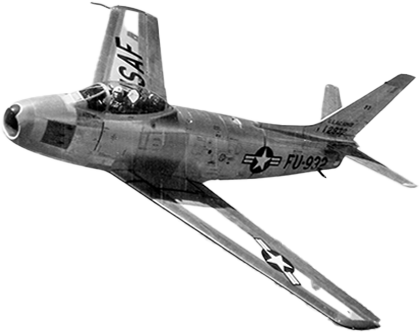
The response was immediate. The United States accelerated deployment of the F-86 Sabre, a swept-wing jet designed to meet the MiG on equal terms. What followed over “MiG Alley” were some of the first sustained jet-versus-jet dogfights in history — high-speed engagements that signaled the arrival of modern aerial warfare.
At the same time, the conflict exposed the vulnerability of legacy aircraft such as the B-29 Superfortress and reinforced the continuing importance of close air support, reconnaissance, and interdiction missions — many carried out by aircraft with World War II technology.
The Korean War ultimately bridged two eras. The aircraft illustrated in Ron’s archive capture this pivotal moment — when world war 2 prop planes and the world’s first fighter jets shared the same skies, and modern air power emerged in the shadow of a growing global rivalry.